Residential
Prioritises daytime demand, available roof, appearance, contracted power and future loads. A battery is studied only when the profile supports it.
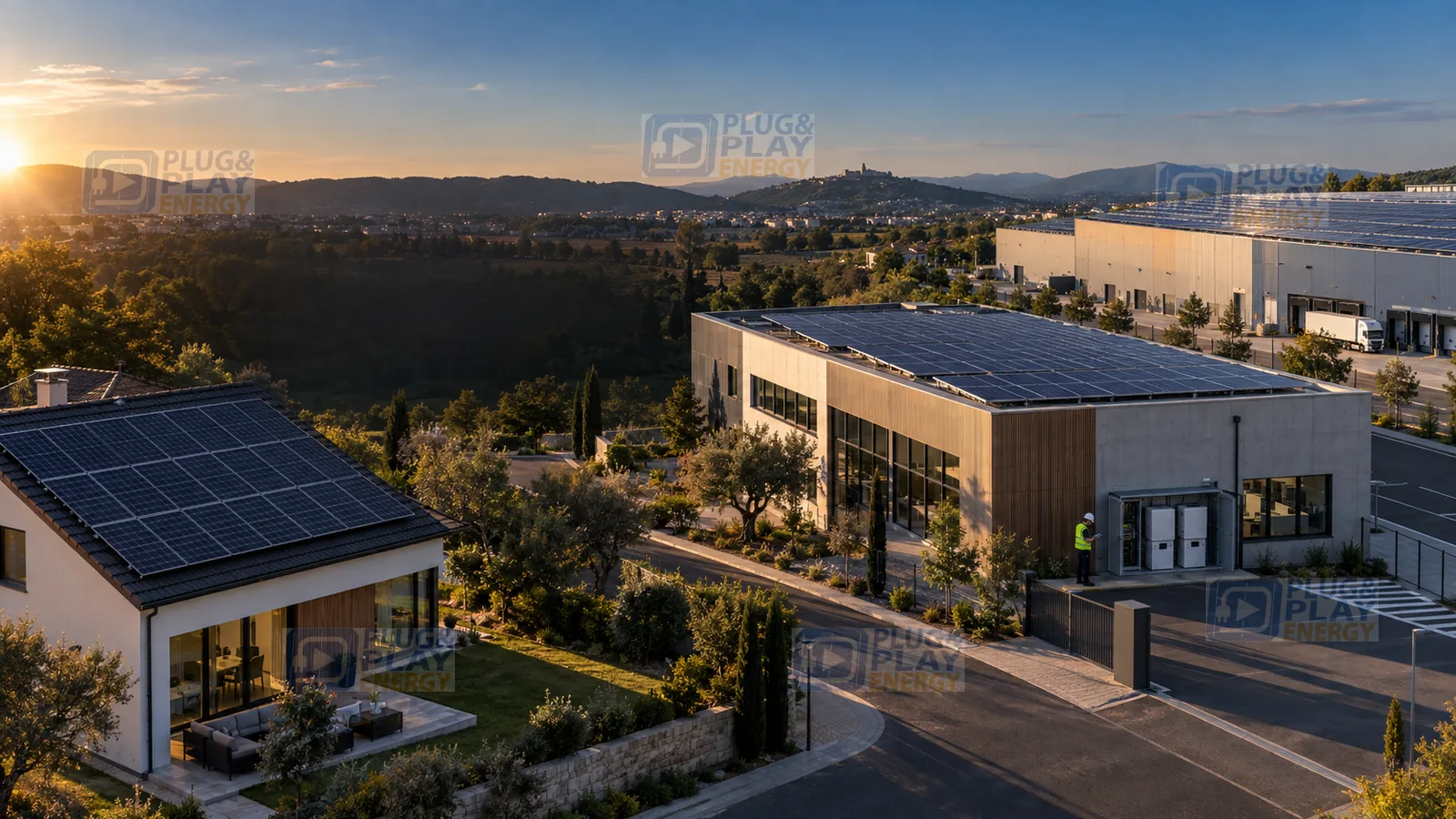
From roof to switchboard: we design the architecture around actual demand, the grid, the roof and operating objectives.
The architecture changes with the demand schedule, grid connection, available space and continuity required by the activity.
Prioritises daytime demand, available roof, appearance, contracted power and future loads. A battery is studied only when the profile supports it.
Targets base-load matching, export control, reliable metering and room for growth without oversizing the system.
Adds DC distribution, selectivity, switchboards, transformation, communications and an operating strategy coordinated with the plant.
The PV field is one part of the system. The technical decision comes from demand, resource, grid and operation together.
Hourly or quarter-hourly demand, seasonality, weekends and base load.
Usable area, orientation, shading, structure, access, wind and environmental conditions.
Phases, voltage, available power, transformer, metering and utility requirements.
Compensation, sale, zero export or dynamic limitation according to the project and applicable rules.
Strings, MPPT ranges, voltages, protection, selectivity, voltage drop and communications.
Extensions, EV charging, storage, backup and supervision without blocking future evolution.
Final selection depends on the single-line diagram, regulations, the grid and current data sheets. This is a conceptual scheme, not an installation instruction.
We work with verifiable product families, but the exact reference is selected for electrical, mechanical and communications compatibility.
Cell technology, dimensions, loads, current, thermal coefficient and compatibility with structure and inverter.
Explore modules →MPPT ranges, inputs, grid voltage, power control, monitoring and grid code.
Explore inverters →Sensors, meter, portal, communications and the export or demand-control strategy.
Explore monitoring →Energy, power, cycles, AC or DC architecture, backup and integration are validated as a system.
View storage solutions →The better the starting information, the fewer assumptions enter the design and the more useful the proposal becomes.
We organise demand, schedules, limitations and objectives.
We define PV field, conversion, metering, control and options.
We check references, electrical ranges, documentation and availability.
We prepare a traceable technical solution for professional review.
Not always. Without matching, control or an export strategy, more power may not achieve the objective.
Not necessarily. Demand, generation and flexibility come first; storage energy and power are then assessed.
No. It depends on demand, production, tariffs, investment, operation, degradation and regulatory conditions.
Those three blocks let us start structuring the project and identify missing information before equipment is selected.
Technical answers for installers, engineers and project managers.
The load curve, solar resource, usable area, grid, exports and project objectives are assessed together. Optimum power cannot be derived from annual kWh or roof size alone.
No. Storage is assessed when shifting energy, limiting power, increasing continuity or managing surplus adds technical and economic value to the specific case.
Voltage, current, MPPT ranges, string configuration, thermal coefficients, protection, grid, communications and mechanical and regulatory compatibility.
Yes. PnP advises and supplies professionals. The proposal is based on real project data and current documentation for each reference.
Editorial and technical review: Plug & Play Energy team. Final selection is validated against the single-line diagram, demand data, regulations and current documentation.